All work Active venture · 2025—Present
Briedo
Four directions. One ongoing attempt to find the problem worth solving.
Briedo is an AI-powered research and Opportunity Intelligence product for creative, marketing and PR agencies. It is being built to help teams investigate market signals and turn supported findings into potential opportunities for their clients.
That is the current direction, not the starting point. Briedo began as Remoute, a service marketplace, and changed three times as each version exposed a more important product or commercial question.
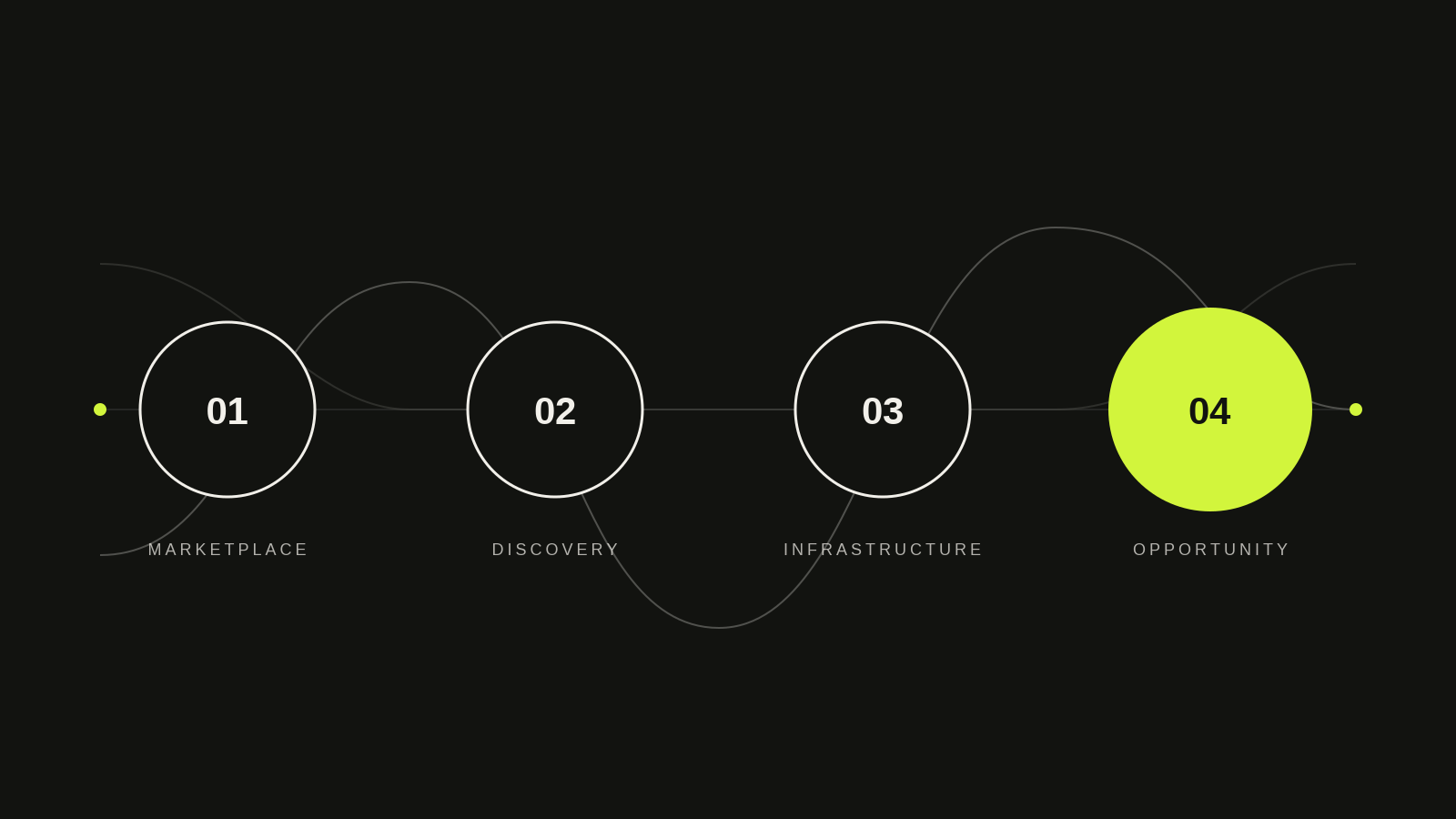
(01)Product evolution
The pivots are the case study.
Each direction was a real attempt to solve a useful problem. The next one appeared when the commercial assumptions, not just the technology, stopped holding up.
- 01
2025
Remoute
The marketplace
The problem
Clients spent too much time searching for independent professionals, while professionals struggled to find relevant opportunities. The quality of a match depended on a request the client often could not describe clearly.
What I built or explored
Remoute explored guided project briefs, professional profiles and AI-assisted matching. The intended flow was simple: brief, match, connect.
Why it changed
The matching layer could not compensate for incomplete or ambiguous requirements. Before recommending the right professional, the product first had to understand what the client actually needed.
Product insight
A better match starts with a better understanding of the work.
- 02
Early—mid 2026
Briedo
The discovery assistant
The problem
Agencies and professional-service teams repeatedly turned vague requests into usable briefs through calls, emails and manual follow-up.
What I built or explored
I built and tested conversational discovery, adaptive questions, structured briefs, missing-information checks, readiness indicators and contextual next steps.
Why it changed
A clearer intake can be useful without being commercially urgent. Existing forms, calls, documents and general-purpose AI could already cover parts of the workflow, and another interface could add friction rather than remove it.
Product insight
Improving a process is not the same as solving a problem people urgently pay to remove.
- 03
Mid—late 2026
Briedo
The discovery infrastructure
The problem
Useful business context was fragmented across forms, calls, emails, documents, CRM records and internal workflows.
What I built or explored
I explored an API-first intelligence layer for ingesting information, reconciling context, separating evidence from assumptions and producing decision-ready outputs inside existing systems.
Why it changed
The horizontal platform required integrations, permissions, reliability work and operational complexity before a strong commercial use case had been validated. For a small bootstrapped team, the architecture was becoming larger than the evidence supporting it.
Product insight
Technical sophistication cannot compensate for an unclear commercial need.
- 04
November 2026—Present
Briedo
Opportunity Intelligence
The problem
Agencies are expected to bring proactive thinking to clients, but relevant developments are scattered across competitors, markets, categories and public conversations.
What I built or explored
The current product investigates external signals in the context of a client brand and turns sufficiently supported findings into opportunity briefs an agency can evaluate. Work includes brand-context onboarding, public-source research, evidence analysis, opportunity generation and quality controls.
Why it changed
This direction is under active development and early validation. The commercial hypothesis, repeated usefulness and willingness to pay still need to be proven with agencies.
Product insight
The value is not more information. It is knowing which information may justify a meaningful action.
(02)Current direction
From a signal to a reason for the next client conversation.
Briedo is not intended to generate endless campaign ideas or replace agency strategists. The working hypothesis is narrower: research what is changing, test whether it matters to a specific brand, and present the evidence and uncertainty clearly enough for a professional to judge it.
Working model
- 01
Signal
Identify a potentially relevant competitor move, market development, audience shift or category conversation.
- 02
Investigation
Check the sources, context, credibility, relevance and what remains uncertain before treating the signal as meaningful.
- 03
Opportunity brief
Explain what was observed, why it may matter, what supports it and which strategic question deserves consideration.
Product principles
- Evidence before recommendations
- Factual claims should remain traceable to credible sources.
- Context over generic trends
- A market development only matters when it connects to the specific brand.
- Investigation before interpretation
- A signal is not automatically an opportunity.
- Human judgment remains essential
- The agency remains responsible for strategy and the client relationship.
- Commercial value over complexity
- Technical ambition has to earn its place through repeated customer value.
(03)What stayed consistent
The product changed. The underlying work did not.
- 01
Reduce ambiguity
Turn incomplete or scattered information into a clearer picture of the decision.
- 02
Move information toward action
A brief, a match, a consolidated context or an opportunity only matters if someone can act on it.
- 03
Use AI for practical work
The model is part of the reasoning workflow, not the product story by itself.
- 04
Challenge the business model
A build is not justified merely because it is technically possible or interesting.
(04)Founder involvement
Product decisions and technical decisions stayed in the same room.
Across the four directions, my work covered the product hypothesis as well as the systems needed to test it. Not every explored capability reached production maturity, and the current product is still being validated.
- 01
Product vision & strategy
Customer segments, problem framing, successive hypotheses and the decision to pivot.
- 02
Software architecture
Data models, APIs, AI workflows, security, reliability constraints and scope tradeoffs.
- 03
AI product engineering
Conversational discovery, context extraction, structured outputs, research pipelines and evidence checks.
- 04
Technical leadership
Implementation order, engineering complexity and keeping the build aligned with the product question.
- 05
Founder judgment
Balancing ambition, resources, differentiation and the risk of building something commercially unnecessary.
(05)Hard-earned lessons
What building it changed in how I work.
- 01
The first problem is not always the real problem.
Remoute's matching problem exposed a deeper problem around requirements, then a broader one around decision context.
- 02
A good technical solution can still be a weak business.
Usefulness does not prove adoption, urgency or willingness to pay.
- 03
Complexity must earn its place.
An ambitious platform is the wrong first product when demand is still mostly hypothetical.
- 04
A pivot should preserve what is valuable.
Research, structured reasoning, contextual understanding and evidence handling carried forward into the current direction.
(06) Founder reflection
The hardest part has not been writing the code.
It has been deciding which problem is actually worth solving — and being willing to question work I had already invested in when the commercial argument was not strong enough.
Briedo is still an evolving startup, not an established success. That is precisely why it belongs here: it shows the part of building that sits between technical ambition and commercial reality.
Building software is one thing. Building a business around software people genuinely need is something else.
Have a product question that needs both commercial and technical judgment?